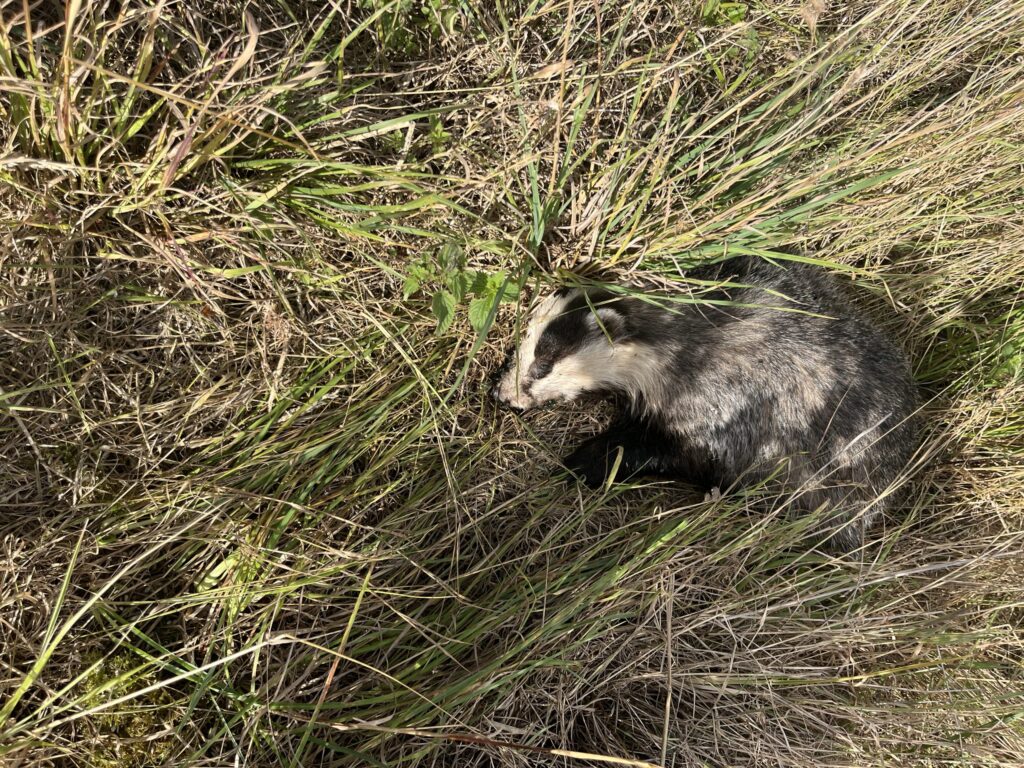
Badgers are disproportionately prone to road mortality, and it’s been studied to death (often literally). The short version: their behaviour, not their markings, is a problem.
Key reasons badgers get hit so often:
- Low eye-shine and poor contrast at headlight height
Their black-and-white facial stripes are high-contrast in daylight, but at night they sit low, absorb light, and don’t reflect like deer eyes or fox fur. Drivers don’t register them early enough. - Predictable routes, inflexible habits
Badgers are creatures of habit to a fault. They use the same paths and crossing points night after night, even when roads bisect territories. They don’t “learn” avoidance quickly, if at all. - Slow acceleration, poor evasive response
When startled, badgers often freeze or blunder forward, rather than sprint back the way they came. That hesitation is fatal at 60 mph. - Peak activity coincides with traffic
Dusk to early night = badger foraging time + commuter / evening traffic. That overlap matters more than volume alone. - Territory size forces crossings
In fragmented landscapes (modern Britain), territories frequently straddle roads. Unlike deer, they can’t simply relocate or expand elsewhere. - Population density
Where badgers are locally abundant, roadkill numbers climb sharply. High mortality doesn’t necessarily mean declining populations — just constant replacement.
There’s decent UK evidence showing badgers are among the most frequently road-killed large mammals, often exceeding foxes on a per-km basis in rural areas. Long-term datasets (county wildlife trusts, DEFRA-linked studies, road ecology work) are very consistent on this.
So no — it’s not that drivers are uniquely oblivious, and it’s not bad luck. It’s a near-perfect storm of anatomy, behaviour, timing and modern infrastructure.
If you’re seeing fresh carcasses with any regularity, that strongly suggests:
- an active sett nearby,
- a habitual crossing point,
- and traffic moving just fast enough to kill but not fast enough to deter crossings.
Mitigation can work (fencing + underpasses), but without both, the body count barely shifts.