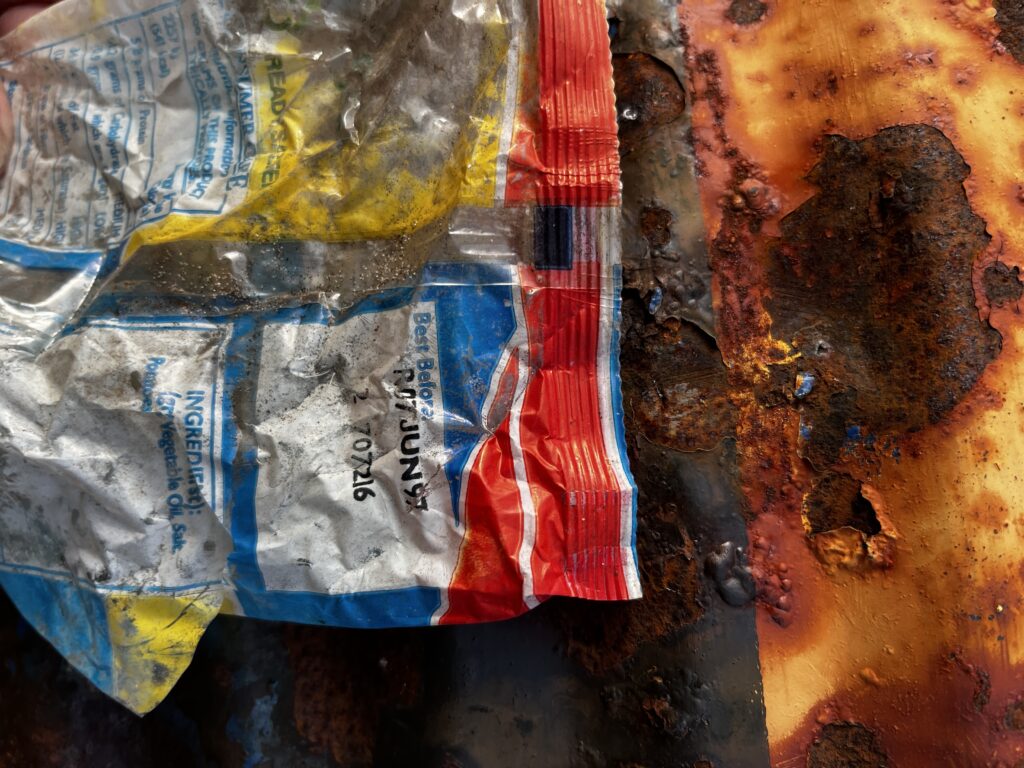
The photo was taken in May 2025, so almost 30 years after the best before. Buried under a metre or so of windblown sand at Thorntonloch.
I pulled the crisp packet out —best before June 1997— from under a metre or so of a rapidly eroding sand dune at Thorntonloch. Here’s the time line.
- The crisps themselves took about a minute to eat (I must clarify I didn’t eat them).
- The potato took roughly four months of sun and rain to grow, then a few hours to wash, slice, fry, season and seal.
- The packet and contents likely clocked hundreds of kilometres by lorry—farm to factory, factory to depot, depot to shop, shop to beach.
- The soft plastic film was made in minutes from oil that formed over tens of millions of years.
The snack vanished in a minute; the wrapper is still here 28 years later and will probably linger for centuries.
A dune is a moving archive: wind buries, storms exhume. What we call “litter” is often a cheeky receipt for a long supply chain that turns ancient carbon into something designed to be used once and forgotten. If we don’t want 2025 turning up in 2053, 2075 or 2125, the fix isn’t complicated to state: less single-use, better deposit/return and take-back, and the basic discipline of not leaving stuff behind.
The coastline is fragile; our packaging really isn’t. That’s the mismatch.


